Looking Back at Our 5 Year Plan
Our 5 Year Plan, 5 Years Later
Dr. Aaron Blocher-Rubin, Founder & CEO
Five years ago, AZA United was known as a nonprofit habilitation & respite agency. It was a good start, but we knew we had to do more. Ideas and opportunities were coming at us left and right, and we needed a way to prioritize. We needed a plan.
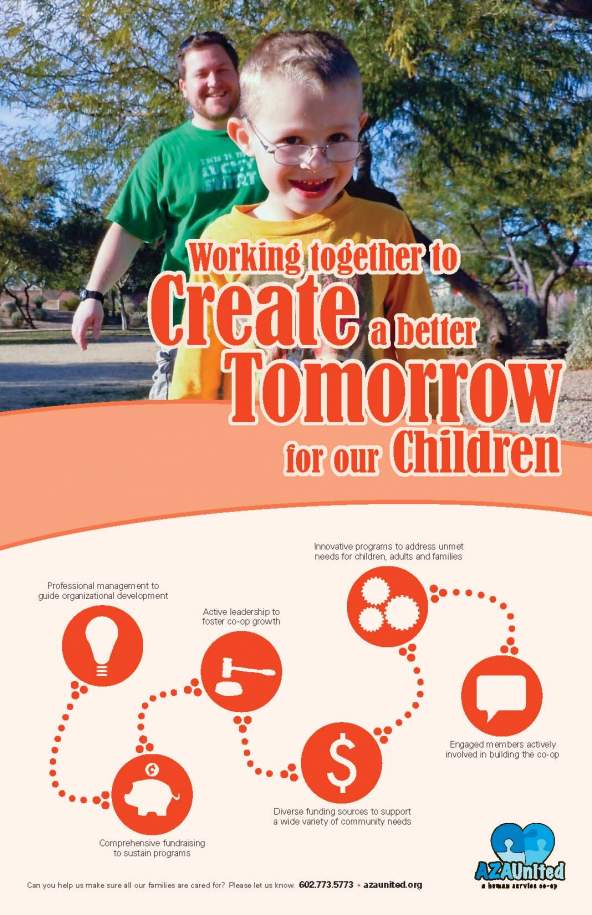
We put our heads together for a SWOT Analysis and some other fancy techniques, and came out with a 5 Year Plan. It looked great on paper, but I was worried no one would read it. So, with the help of some students at the Art Institute of Phoenix, we made it visual. Four vibrant posters have been on display in our lobby ever since, representing our 4 big goals and their objectives. My hope was that these daily reminders would keep us on track.
Now our five years are almost up. Yikes! It’s time for self-evaluation. Five years later, how are we doing?
GOAL #1: A sustainable and progressive Human Service Co-op with growth opportunities.
Objectives:
- Stable and diverse funding sources – no more than 80% of total revenue through DDD
- Effective and comprehensive fundraising – 10% total revenue through grants and donations
- Parents actively involved – board members, committees, volunteers, and feedback
- Highly qualified, professional management team and efficient administrative staff
- Innovation of new programs that address unmet needs in the community
How are we doing?
Last year, DDD services accounted for 77% of our total revenue. Compare that to 98% in 2010 – we have certainly diversified! Our funding sources now include behavioral health, several insurance carriers, various schools, and fundraising. “Stable” is the key word, and the lesson we have learned is to never be too dependent on one source as they are all constantly changing. Fundraising hasn’t become as big a slice of the pie as we imagined, totaling only 4% of our total revenue in 2014, but that’s much better than the meager 1% we had in 2010. Plus, we’ve found a really great way to use those funds – scholarships for families to participate in our programs on a need-based sliding scale. The Charitable Organization Tax Credit has been a huge help to make donating possible for most people, and I hope this fund continues to grow so we can reach our goal of giving any family whatever services they need.
Looking at parent involvement, almost all of our board members have always been parents of children receiving services. That was no accident – AZA was founded on the idea that putting parents in charge of governance would lead to an organization that is responsive to real community needs. It’s been a work in progress, but our current board is simply fantastic and more engaged than ever before. I’m very excited to see this group take ownership and move the ball forward to make us all dream bigger. We haven’t been as consistent with committees, however, and we still need to create a better platform for all AZA parents to give feedback and volunteer their talents. I’m hopeful that our planned launch of a new-and-improved AZA Parents Association (AZAP) will finally make that vision a reality.
In regards to building our management and administrative teams, we have come a long way. In 2010, we barely had an org chart. Today, we have 5 fabulous directors, each overseeing clearly defined departments with goals, budgets, and administrative staff to keep the motor running. We try hard to promote each person’s professional development by supporting their participation in conferences, trainings, and other activities to build their skills and competencies. Sometimes nonprofits get a bad rap for having too much “overhead” (see Dan Pallotta’s world famous TED Talk). It’s true that mission-based organizations shouldn’t waste money on extra paperwork and bureaucracy, especially when people donate to support the cause. That said, we all know how frustrating it can be to deal with a poorly run company. Efficient and helpful administration is essential, as there are so many moving parts and areas needing attention every day. We have about 10 people juggling various administrative roles now, and I don’t know how we could function without them! They are a critical element to making services work, and making systems and processes as user-friendly as possible for our families and direct care staff. Like many other things in life, it takes a team effort to succeed - everyone’s role is essential.
As for innovation, I am very proud of some new programs that have come out of AZA. With grant funding, we developed an Autism Awareness Program for general education students that have a mainstreamed child on the spectrum in their class, and it’s free for schools! Our speech director created a 7-week parent training program called Family Fundamentals that is appropriate for all ages, and available to any family through our scholarship fund. Our Behavior Coaching program has opened a door into a whole new kind of holistic family support that I never imagined. One summer we even offered swimming lessons, after a parent suggested it in our Annual Meeting and others agreed it was needed. Many other projects are in the works, and I hope that AZA United continues to be a “hub of innovation” for the autism community, where good ideas can flourish. The key, of course, is making sure the final result is accessible for everyone. That’s the hardest part, and we know we still have a lot of work to do there.
GOAL #2: A model of excellence in service delivery.
Objectives:
- A local leader in DDD services (habilitation & respite)
- Efficient and effective systems of recruiting and retaining field staff
- Services accessible to all
- Replication of the service model outside of Maricopa County
- Integration of current evidence-based and best practices into all services
- Ongoing evaluation and research of service delivery model to study effectiveness
- Supervisory staff of licensed or credentialed professionals in relevant disciplines
- A local leader in providing ABA services funded by insurance or private pay
- Self-directed and individualized programs for families
- A model of family-centered and transdisciplinary care
How are we doing?
To me, this goal is the most important one, because at the core we are a direct service organization. Our mission is to help as many families as possible with individualized supports, and we can’t do that without an excellent service delivery model. “Excellent” is a subjective term, but the objectives for this goal were designed to get us to a place that we felt would meet this standard.
Being a local leader in habilitation and respite services requires two elements – quality and quantity. These are without a doubt high volume services, for three reasons. First, there are so many families in need that qualify. Second, the required qualifications for a provider are basic enough that there exists a nearly unlimited supply of potential workers out there. Third, the reimbursement rates from DDD are so low that high volume is really the only way an agency can financially survive. Over the past few years we have grown to serving several hundred families with several hundred-thousand hours of service per year. We have a huge and constant inflow of field staff applicants, and our systems to keep things moving and organized continue to improve. Although we intend to keep growing (we also have several hundred more families needing services), we have certainly achieved the goal of quantity. So what about quality? This one is much harder. In my experience, the general standard for habilitation services among all agencies has been notoriously low. Providers receive little to no training or support, and parents must carry much of the burden to make services successful in their home. It’s easy to point out the flaws, but not so easy to come up with solutions when the funding simply isn’t there. However, after 10 years, we have finally launched what I call Habilitation 2.0. This year we made some major changes to raise the bar, increasing training, pay, and hands-on support for all habilitators. Our budget is tight, but with enough volume it can be sustainable. More importantly, it gets us closer to that goal of excellence and the objective of being a local leader in DDD services.
Another critical objective is making services accessible to all, especially the most underserved groups. We have made progress in this area, but not nearly enough. For example, we have several bilingual Spanish speaking lead staff and are able to provide some services to monolingual families, but the quantity and quality is nowhere close to what we can do for English speaking families. We also know that there are many families out there who don’t know how to access services, or may not even know that such help exists. How do we reach them? Another major limitation is that we don’t have services available for all ages. In short, we have a long way to go, so this objective needs to remain a top priority as we focus on strengthening our systems in the next 5 year plan.
Replicating services outside of Maricopa County has not happened yet. Looking back, I think we misjudged how long this would take. It’s not that we can’t do it. The challenge is doing it well, and I don’t believe we are ready. Before we stretch that far, we need to establish more locations within Maricopa County. When that is successful, we will revisit statewide expansion.
The integration of evidence-based interventions and best practices into our services has really snowballed in the last few years, which is exciting. We now have three Clinical Directors who, with the help of their amazing teams, have a passion for finding the best of what’s out there and infusing it into our programs. Applied Behavior Analysis (ABA) is the obvious one, but we haven’t stopped there. Our behavioral health team utilizes Alan Kazdin’s Parent Management Training (PMT) model, as well as Acceptance and Commitment Therapy (ACT). Our social groups draw heavily from Michelle Garcia-Winner’s Social Thinking. All of our home-based ABA programs pull from a variety of techniques and sub-specialty approaches within the field. As we discover new treatments, tools and protocols that can improve the way we serve families, our task is to find ways to use what will be beneficial without disrupting any good things we already have going. More is not always better.
Once good programs are in place, we want to measure them to see if they’re working as expected. Our clinical services do an excellent job of measuring individual child progress. On a macro level, however, we have not yet figured out how to measure the overall success of a service. Since every child differs in their starting point, their individualized goals, and the level of services received, it is very difficult to measure one thing that represents everyone. We have been working on it, though. This year we completed a training series with two outstanding nonprofit consultants through the Alliance of Arizona Nonprofits who specialize in program evaluation. We came up with some great ideas that we are now exploring, so I expect to see some new measures in place soon that will be a huge help in improving our overall service quality and effectiveness.
With 10 BCBAs, 3 SLPs, and a number of clinical staff on their way to professional licensure, we are building quite a robust team. I hope to see more disciplines join the mix in future years, such as counseling, physical therapy, and occupational therapy (OT), to achieve our goal of transdisciplinary care. In the meantime, we believe we have become a local leader in ABA services. Our Hab-M/ECA program serves over 100 families, and we have over 20 Home-Based ABA programs with highly trained ABA therapists. On a personal note, I was recently elected the next president of the Arizona Association for Behavior Analysis (AZABA). We have always emphasized the importance of individualized programming that is built around the true needs and priorities of the child’s family. We do not believe in clinicians dictating what is important. To be a model of family-centered care, the family must truly be at the center of every decision. We, as professionals, are here to provide guidance and suggested courses of action that we believe will be successful. From there, we work together to develop a plan that everyone believes in.
GOAL #3: A community resource to enhance quality of life.
Objectives:
- Programs to address needs for the whole family, including social & recreational
- Lending libraries and therapy materials for families in need
- A resource for information & support for concerned families without a diagnosis
- Wellness and support programs for parents and siblings
- Partnerships and collaborations with community organizations and leaders
- Consulting services to assist other entities or individuals helping people with ASD
How are we doing?
This goal was meant to keep us focused on a broader vision, beyond just billable services. This goal is about the extras that mean a lot to families and their quality of life, but may not be high on the priority list for profit-minded agencies. It’s a commitment to help fill the gaps and make sure families always have somewhere to turn when they need help.
We used to host more social and recreational activities, such as an annual pool party and many family events. As services and other events have grown, we’ve struggled to maintain that priority as others became more pressing every day. I would like to see more happening here in the future. It’s a perfect fit for some motivated members of our Parents Association who enjoy leadership roles that make a difference. We still haven’t had the AZA camping trip we talked about years ago, although we did enjoy some fun evenings with Mom’s Night Out and Dad’s Poker Night.
We used to have a Lending Library for games, equipment, and therapy materials, but it wasn’t as popular as we expected. We do still provide free flashcards, program guides, and other supplies for families receiving related services. With the help of the HollyRod Foundation, we also gave out dozens of communication tablets this year to children in need. Our next plan in this area is to help children learn how to ride a bike by loaning out Strider Bikes, supported by donations from our good friend Lady La. Watch for an announcement coming soon about this exciting new opportunity!
One of the best developments in the last 5 years is the establishment of our Outreach Team. These three outstanding staff members are all parents of children with autism, so they can relate firsthand to the challenges our families experience every day. They have many roles, including personalized support and guidance for any family who contacts us. With their help, we are able to help families at any stage figure out what they need and what is available, for both AZA services and other community resources. We also have a free Parent Support Group that anyone can join, and within the next year we plan to begin offering the Sibshops program to support siblings of children with autism.
Since AZA United started 10 years ago, we have always believed in collaboration. We exist because we care about helping people affected by autism, and working together with others who share that value leads to better results for everyone. It has been a wonderful experience to work with so many organizations and professionals over the years. I will say that there was a time when the vibe within the autism community did not feel so collaborative, but it has really changed for the better.
The final objective for this goal was to provide consulting services for other entities that help people with autism. We have worked with many schools and other programs in this capacity, such as Headstart and the Arizona Autism Charter School. We plan to continue expanding this line of support to improve service environments in places like group homes, day programs, daycares, and learning centers.
GOAL #4: Facilitating professional growth to build capacity in the community.
Objectives:
- An infrastructure that encourages all staff to grow professionally and advance
- Field experience programs for local college students in related fields
- A local leader in conference or seminar presentations
- Trainings for professionals that are recognized or credentialed
- A statewide authority on autism spectrum disorder and related treatment
- A statewide authority on applied behavior analysis (ABA)
How are we doing?
Of the 4 goals in our 5 Year Plan, this one was always my favorite. On the surface, it may seem like an odd fit for a mission-based organization whose priority is supposed to be the families, not the employees. My view, however, is that both are necessary. Obviously, you can’t have great services without great staff, and they won’t be great if they don’t feel valued. But that’s only half of it. The other half is a long-term vision. One of the most common issues that families report is feeling isolated. It’s hard for their child to make friends and be included in the community. They may not get invited to birthday parties. They may get judgmental looks from other people at the grocery store when their child is acting out. They may have a hard time finding other kids for playdates. When they meet other parents of typically developing kids, they may quickly find that their daily experiences don’t have that much in common. It’s not that other people don’t care, but many of them just don’t understand. So imagine a world where everyone does understand. They understand because autism has been a part of their life. They are comfortable talking about it, and they enjoy interacting with the kids. Wouldn’t that help improve quality of life for autism families? We can’t reach everyone, but we do hire hundreds of people every year to work as habilitators. Many of them are college students, or still figuring out what they want to do. They may not end up working in this field long-term, but the impact of this experience should last a lifetime. When they have their own kids, they’ll make sure that classmates with autism are invited to their birthday parties. They’ll welcome parents with open arms and show them that there’s no judgement to worry about here. They’ll tell their friends and family about the special place that kids with autism have in their heart, and how important it is for everyone to be inclusive and supportive. That’s the role that we can play in changing the status quo in our community for the long-term. That’s why I love this goal. Today’s employees are the autism community’s future professionals, friends, and neighbors. We need to make sure they have an experience that fosters a lifelong sense of compassion for people with autism.
Over the last five years we have focused extensively on building career paths for clinical staff. We have so many habilitators who want to continue working in this field, and not enough Behavior Analysts or Speech Language Pathologists. How do we get them from point A to point B? The solution for us has come from the development of new departments and services that each have several layers of staffing. The BCBA Clinical Supervisors provide the required year of supervision and mentoring for Bachelor’s level Assistant Clinical Supervisors to achieve their board certification. Experienced Habilitation Therapists can be promoted to the role of ABA Instructional Therapist, which involves more training and higher pay. One of our primary goals was to not only have a career path available, but to make sure every new employee knew exactly what it was. Our Careers in ABA flyer has been a huge help to accomplish that.
The field experience for college students did not happen as quickly as we’d hoped, but it is finally starting next month! ASU is launching a new master’s degree in Applied Behavior Analysis, and all students will get hands-on experience at a variety of schools and organizations that provide ABA services. We are very excited to be participating as a practicum site for students.
In regards to conference presentations, we took this objective to another level when we decided to host our own conference for parents and professionals, which has become one of the best around and always includes CEUs for BCBAs. We are now planning our 5th Transdisciplinary Autism Conference for next April, with exciting keynote speakers to be announced soon. We’ve also hosted two Spanish autism conferences, and countless training workshops and seminars. Many of our lead staff present in other local and national conferences regularly on a variety of topics. Each experience provides us with a platform to share our knowledge, and an opportunity to network with and learn from others in our field.
The final objectives for this goal were to be recognized as a statewide authority on autism spectrum disorder and related treatment, including ABA. Our thinking here was that AZA United needs to have the professional competency and credibility to help advance issues related to improving treatment and services for autism in the state of Arizona. I feel confident that we have made great progress in this area based on the skills and qualifications of the people that work here, the relationships and reputation we have among parents and colleagues, and the scope of services we provide. However, I am not sure how broadly we are perceived in this respect among other authorities. We have certainly worked a lot with DDD, and are increasing our involvement in the behavioral health system. We collaborate extensively with many other organizations and associations, and serve on various boards and committees for state agencies and other entities. We have not had much involvement in legislative activities though, and our media presence has been minimal. People who do not know us well are often surprised to see how much we do. I don’t think we’ve quite reached the status of “statewide authority” in the eyes of the general public or other major authorities. I do believe, however, that we’re well on our way. When we get there, the most important thing will be that we never lose sight of what we are here to do in the first place – help as many people as possible. Of all our accomplishments in the last 5 years, that shared understanding of who we are is what makes me more proud than anything else.
Aaron Blocher-Rubin, PhD, BCBA, is the founder & CEO of Arizona Autism United. You can reach him at Aaron@AZAunited.org. He would love to hear from you!